Wednesday, February 6, 2008

Introducing Remica Bingham to Poetic Notes


This year I will periodically invite outside folks as a guest blogger. I saw Remica Bingham on the campus of Howard University last year. She and poet Tara Betts both presented papers on Lucille Clifton. What appealed to me about their papers were the ease and fluidity with which they delivered them. They didn't strike me as straight-laced academics. I had a haunch they they knew something about poetry, in a way only a practicioner would know. They weren't just speaking from an esoteric space. The subjects of their papers was their mentor-teacher. They probably chipped their teeth as poets reading Lucille Clifton or studying with her as fellows of Cave Canem.


After reading so many blogs last year, I thought I'd borrow a few ideas from Blog deity E. Ethelbert Miller and Tayari Jones. (You can google either of them to check out their lively blogs.)


I have done brief interviews on here previously but with the guest bloggers I thought I'd give them a blank sheet (or screen) to speak to us about something that they are intimately familiar with. Without further ado here's Remica Bingham:


There are very few poets in this country that can survive without a day job and I am certainly one of them. My job, however, does afford me the opportunity—the time and space—to write more often than not, and I am grateful that this is the case. Currently, I’m at Norfolk State University, an HBCU in Norfolk, Virginia. My proper title is Writing Competency Coordinator for Institutional Effectiveness and Assessment, which basically means I handle a big exam. I’m an administrator, and the move from teaching has been a strange one, but I have gotten a sidelong glimpse into the administrative life. I’m hoping it will give me some sharp insight when I am finally able to return to the classroom.

Though I was a bit leery about engaging in a 9 to 5, five days a week (and a few Saturdays each semester), it has been a beautiful thing as far as my writing is concerned. I have gotten more done here than I think I would have been able to if my primary work were in a classroom setting. You cannot leave the classroom; the students--their thoughts and personal lives--stay with you constantly. You worry over them, think on them, even write about them long after they’re gone and the day is over. As I don’t have a set group of students that I work with on a continual basis, this is not the case with my current position.


As a poet, I lean towards the narrative more often than not. I am interested in the minute details that create the bigger pictures of our lives. Clarity is something I strive for in all of my work, and plainness, in the sense that I want every line, every word, every comma to be used in the best way and as sharply as possible. As a reader, I want to come to the page and find some foundation, some grounding, in the things that make up our real lives. So, as a poet, I am intensely interested in everyday occurrences that help define who we are and how we are able to survive in the world. The only ideas I have about craft that I am married to are: to always use the essential phrase, never the incidental one and revise, revise, revise. Also, I think it’s important for young writers (not necessarily in chronologically, but in practice as well) to know is that all good writers should read ten times more than they write. For every ten poems you write, you should have read at least 100.


Making a living as a poet is almost an oxymoron, but some do. If I could change one thing about the process it would be that the business world that governs over the publication of our writing would be more like, or at least more appreciative of, the actual process of completing a poem. You don’t expect artists, or those who profess to love art, to be cutthroat or so preoccupied with numbers that they miss the importance of what is being said and how. Poetry isn’t about the numbers. If it were, we’d all be failing miserably.

Monday, January 21, 2008

Prelude to a New Year/ New Blog


A few weeks have gone by since I last posted. It's a New Year. So, I need to step it up on all fronts, including this blog. I think the biggest challenge is not knowing if people actually read this blog aside from your friends and family (thank you all!) When I go crusing in cyberspace or blog-o-sphere I note how many bloggers have an audience either by publishing, doing something fantastic, or achieving minor fame in some of other way.


So, to my audience, or the audience that may come, I've decided to make my blog more personal, and hopefully interesting by including posts that are relevant to people like me: students, artists, those at the start of their careers, those needing information about publishing or getting started, or those seasoned artists who wish to connect with a younger voice, dare I say generation.


A lot has happened. The political climate is changing rapidly. It's almost impossible to keep track of anyone's campaign (except if you're like many people and have concluded that the election will go the way of status quo.)


I am not a particularly political person. However, I consider myself a conscientious individual. A person concerned about the inside life and thus the outside life: the two are intertwined. I want to not just see a change, which has become a bit cliche, but I'd like to smell it, taste it, know its there because you are actively participating in that change. But, what does change mean, to those of us who aren't running for office?


For me it means, being able to wake up proud of this country. T know that one's voice makes a difference, matters outside of those who think as you do. That the "people" are able to resist the machine and take their destiny in their own hand. I'd like to do my part to make sure that facism is not synonymous with American Democracy. I'd like to know that working class and the poor feel that they, too, are a part of America. Not like those characters in Langston Hughes' poem who not only aren't aloud to Sing America, but are relegated to the Kitchen.


How many of us are trying to break out of the cage, to sing America, but have to clock-in at McDonalds?

Monday, December 31, 2007

Happy New Year from Beltway Poetry Quarterly!
http://www.beltwaypoetry.com/

We begin 2008 with a rousing new issue of the journal, celebrating political poetry "borne out of a hunger." The Split This Rock Issue features seventeen poets who are participating in the upcoming festival of the same name, either as organizers or readers.

As co-editor Regie Cabico writes in his introduction, these poets sing "about gentrification, pop culture, immigration, war, heritage, disability, history and American iconography" to create a home "in the gut of a government that should hear, swallow, and ingest verses of provocation and witness."

Split This Rock Poetry Festival will take place in Washington, DC March 20-23, 2008. In addition to Beltway Poetry Quarterly, other co-sponsoring organizations include the Institute for Policy Studies, Sol and Soul, The White Crane Institute, Washington Friends of Walt Whitman, and Beloit Poetry Journal.

The Split This Rock Issue of Beltway Poetry Quarterly features poems by the following authors:

Winona Addison * Naomi Ayala * Sarah Browning * Grace Cavalieri * Teri Ellen Cross * Heather Davis * Joel Dias-Porter * Yael Flusberg * Brian Gilmore * E. Ethelbert Miller * Princess of Controversy * Tanya Snyder * Susan Tichey * Melissa Tuckey * Dan Vera * Rosemary Winslow * Kathi Wolfe

The Split This Rock Issue (Volume 9, Number 1), is co-edited by Regie Cabico and Kim Roberts. The issue is available online now at:

http://www.beltwaypoetry.com/

Saturday, December 22, 2007

The end of the year gets me a little nostalgic. Not sure about everyone else but time seems to literally be flying. I recall as a teenager figuring out that year 2002 would make me eighteen years old. For whatever reason eighteen sounds BIG and LIBERATING, and largely it was. Then 2003 happened, 2004, 2005 . . . and so on. It is important to be conscious of time as you move through and reflect in hindsight. Lately, I’ve pondered what can be carried into the future given modernity—the fleeting present—making things past and future. Perhaps, all that we can take with us from one year to the next are our memories and stories, remembering the unsaid as well as the said, remembering those whom we’ve hugged and later watched the earth hug their coffin as they transition to the other world. Here are some highlights of 2007 that I wish to share with you. If you have a 2007 moment you’d like to share, by all means, please send them to me.

Best Movie?

So far, my favorite film of 2007 is “Talk to Me.” This film saved me from being a cynic of black cinema. When you look at the mile-long list of crap that’s being produced and bankrolled it easily give me the impression that there are no intelligent black actors, directors, or writers out there. Obviously, this is not true; nonetheless, we need to push a little harder to get quality movies out there. Kudos to Oprah Winfrey and Denzel Washington for teaming up to create “The Great Debaters.”

Best Blog?

Tayari Jones has a marvelous blog http://www.tayarijones.com/blog. It’s multifaceted, the entries extend beyond little post-it notes that so many bloggers tend to produce. The subject matter ranges from personal to political—yet all grounded in the writing life.

For local happenings and humorous commentary on politics and culture, I like to read E. Ethelbert’s blog. He’s a writer, but more than a writer he is an activist writer. You get critical commentary on matter of labor, politics, race, current events, job openings, causes one ought to know about. Become a part of the literary and activist world of E. Ethelbert Miller, check out his blog at http://www.eethelbertmiller1.blogspot.com/

Best Moment?

The summer of ’07 was the greatest. I hopped on the Chinabus and went up to New York City to Central Park to hear Amiri Baraka and Sonia Sanchez read from their respective corpses, then a post-show conversation about how the Black Arts Movement began ensued. It was a highlight of the year. And, I got to see Asha Bandele and my teacher and poet-friend Tyehimba Jess.


I could go on and on but I would love it if my readers can tell me what their best CD of 2007 was? Best Books? Or any of bests they’d like to share.


Thursday, December 13, 2007

Ann Darr (1920-2007)

I received this note moments ago--

"We note with sadness the passing of Ann Darr, a prominent DC poet. Dryad Press has started an 'In Memoriam' page on their website that is terrific. The link reprints poems, and gives biographical information. http://www.dryadpress.com/AnnDarr.htm

Though, I did not personally know Ms. Darr, I tend to look at the writing community as a body so when someone leaves that body, it's almost like suffering a lost limb or digit.

Merill Leffler, publisher of Dryad Press is accepting remembrances of Ann Darr; you may sent them to publisher@dryadpress.com

Monday, December 3, 2007

I'm listening to Lauren Hill's Selah. It's a beautiful song. A good friend of mine first burned this song on a cd that she created just for me, on Valentine's day a few years back. She created an entire soundtrack for me. And in the playbook was this song with a note that read something like I think everyone feels as though they need to be "saved from themselves" sometimes. I think you do that for me when I need it: nagging me to sleep and eat all that. So, thanks... This one's for that.

Ain't it funny how one song can unlock the flood gates?

The weekend was spent writing papers. On Sunday, I visited a Buddhist community center and saw some of the happiest looking people I've ever seen. And they were very warm in welcoming me into their space. I love the idea that we are accountable for our happiness. That there is something in us that really can direct the kind of energy or results we want to see.

Back to writing papers.

Tuesday, November 20, 2007

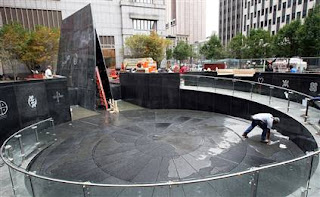
The African Burial Memorial


This past summer I hopped on the Chinabus and made my way back home, to New York City. I had spoken to brother Rasul on several occasions about the African Burial Memorial. It took me some time to process that New York had slaves. I always believed that my home was the place that enslaved brothers and sister fled to.

What follows is a brief discussion about this special place. My thoughts are in bold italics and Brother Rasul's are in regular typeset. I hope each of you will take your family and friends and learn about this part of history.


What follows are my personal observations and are not necessarily reflecftive of the positions of the National Park Service. While I am a volunteer there, I am speaking here for myself, not for them.

I am deeply appreciative of the opportunity they have afforded me to honor the ancestors through my efforts, but I am a spokesperson for myself alone, not for the National Park Service.


1. How did you first encounter this memorial?

nomenclature: the burial ground, the national monument, the memorials - city memorial in Foley Square, Triumph of the Human Spirit, and the federal memorial, The Ancestral Libation Chamber Memorial dedicated the weekend of October 6Th. We have since seen some 40 thousand visitors to the monument.

In 1991, when it was discovered by the African Descendant community what had been uncovered by the government and what disrespectful treatment was being afforded the discovery, the burial ground became a focus of action for the descendant activist community and word went out urging folks to attend the regular protests, ceremonies, and commemorations that were being conducted to support the elders who were leading the fight to halt the exhumations and the construction and assure proper respect for the remains of the ancestors.

Like many others, as my work schedule permitted, I visited the burial ground to lend my support. After the initial success and the dispatch of the remains to Howard for study, I assisted the government funded Office of Public Education and Information, both as a volunteer, at their various educational events, and as a volunteer consultant in automating their mailing list.

After the return of the remains from HU and the subsequent designation of the burial ground as a national monument, I began to volunteer as a docent, giving tours of the monument and the art work commissioned for the burial ground. I have been giving a tour of "Old Manhattan and its African Past" for many years, and the burial ground was a logical involvement for me, especially after my retirement.


2. What impact has working with the African Burial Memorial had on you?

Impossible to truly assess. It has been a profound turning point in my life. It has set me on one of the steepest learning curves of my intelectual life and on a spiritual journey that has only just taken its first baby steps. I have embarked on a literary challenge that is testing my craft in new and expanding directions.

The Burial Ground has become a focus for my retirement. There is the time there doing tours, the time spent reading, digeting, considering and learning new things about Manhattan and its African past, the efforts to capture the voices of African New Yorkers in my poem-becoming multi-media-performance-piece, and the persuit of the spiritual understanding I am being offered - all this and much more that I don't even have words for.
Can you recall how it has affected others?

The reactions vary, from surprise at all that visitors have not known before, to appreciation for the recognition and acknowledgement the ancestors are receiving, to a profound sorrow at the circumstances of early African Manhattanites. The many students of every age leave with an understanding of their history, Euro and African descendant alike, that was not previously available to them. The affect on them will only become evident as they become adults and we see the real impact of what they have learned on their committment to justice and peace.

There are those in the African descendant community who harbor deep disapointment that the sacred ancestroral grounds are not under the control of the African descendant community. The government building and the present federal memorial area should not, these elders suggest, have been built on at all, but the grounds should have been preserved as a completely undeveloped green space with signage.

While I respect and understand their position, I think that the educational potential of the monument as a national monument, with its visitors center and memorial, offer a greater educational opportunity, one that would be understood by the ancestors whose remains we honor.


3. How frequent do tours take place?

The visitors Center is currently housed within the Federal Building at 290 Broadway open from 9 to 5, Monday through Fridey, except on Federal holidays. There is a 25 minute video available and a walking tour of the commemorative art work in the lobby of the building on the site as well as of the memorial. Sometime in 2008, we will see the opening of a new visitors center in teh 290 building that will have its own enterance and allow us to be open 9-5 every day except major holidays.

Currently, there is a Park Ranger available at the memorial to provide tours of the The Ancestral Libation Chamber Memorial 9-5, every day except major holidays.

Group tours can be arranged by visiting the official National Park Service burial ground web site at http://nps.gov/afbg. Tours can be arranged for Monday through Friday, 9 to 5 or at other times, by special arrangement. Off site presentations can also be arranged. The current visitors Center can only accomodate 30-45 people at a time for a presentation of the video about the burial ground and I recomend that groups plan a visit of 90 minutes to two hours to fully benefit from the monument's resources. When the new visitors center is opened next year, we will have facilities to accomodate larger groups.

Music, Memoir and Muse

Nothing is as bad as it seems. The semester is moving ahead so fast. I'm trying to be productive (at my own pace, of course.) The weather is changing so fast. It's almost like it was warm, then, I blinked at it was cold. Thanksgiving is on Thursday. This is really is one of my favorite times of the year. The rainbow of leaves falling every day.

I've decided that I'm not going to worry about school anymore. It will work itself out. I always arrive on-time, eventually. I really want to focus on my grad school applications and perhaps, get back into the groove of writing. I really want to have a collection of poems finished early 2008. At one point, I thought I was close to finishing. Then, I started writing some more and all sorts of things fell out.

E. Ethelbert Miller has this phrase that we should know"How many books are in you?" How strange to think about that sort of thing. I love when books introduce themselves to me. I love the discovery of writing. I hear voices, and people talking, and the music of a bygone period in my life and I get excited and start writing. There are also times when we write not just to remember but to go back, because happiness is more often remembered than actually lived. Who has time to think about being happy when you're happy.

The same is true of listening to music. When I wanna hear a song it has little to do with dancing and more to do with remembering who I danced with when that song came out. How it felt to be inside that skin, in that moment, dripping, now an echo.

Thursday, November 8, 2007

At Howard University, if you are in the college of Arts and Sciences--as I am--taking Swimming before you graduate is mandatory. I hope to write about this experience.

Some feeling about swimming: it's all good until, the instructor start talking about jump into the eleven feet. Last time I checked I was only five foot eleven. Not eleven foot five. . .
The Legacy Awards went very well. I think Sonia was proud that such a cross-generation of poets connect to her work.

I'm just now shaking loose her poems from my inner ear. They just fizzled and would not leave. There's one poem of hers that simply loops everytime I think of it.


Personal Letter No. 3

nothing will keep us young you know
not young men or women who
spin their youth on cool playing sounds
I say these lines to myself trying to unpack the wisdom of youths being spend on cool playing sounds. It's really a beautiful poem just as so many of her poems in her first book Homecoming.

Wednesday, October 24, 2007

Rainy Day Reflection


  • I'm listening to "Shh...Peaceful" by Miles Davis. Yeah, yeah, I know the title is ironic given the volatile and reputed violent nature of this musical genius but who says a brother can like someone's art but not so much everything about the artist. They call that ethical relativism, right?


  • Rainy weather is my favorite weather.


  • I'm reading a collection of essays by the Toure`. You should check him out in case you have not already. His website is http://www.toure.com/


  • I have so much to do in way of school work, grad school applications, and still need to eat!!! I need to get my hands on a copy of Broke Diaries.


  • I'm looking forward to the Legacy Awards that the Hurston/Wright Foundation has every year. I'll be doing a tribute for Sonia Sanchez with three other writers.

Tuesday, October 16, 2007

Midterm Reflection

This week marks midterm season, which means a little over a month left to school. There seems to be, unecessarily so, a long laundry list of things to do before getting out of here. I don't have a problem with my classes (except, Swimming and my Playwriting class.) I recall when I first got accepted to Howard my recruiter said to me "It's a lot easier to get in then to get out." I didn't quite grasp her meaning until now. My problem is one of patience. I want to break free like those migratory birds and show the colors of my coat that I recently discovered. I have so much writing I want to do. I want to find a job. Prepare for my MFA program. Start my life! School seems to be holding me back.

That aside, there will be some things I will miss about being a Howard student. There's something mythic about this space. When my peers and I talk in class we can hear our voices reverberate against the walls. If you listen closely you can hear other voices blending with our own. When I enter certain classes, I hear Ossie Davis and Carter G. Woodson and Frederick Douglass joining in on our conversations about uplift and progress and being conscientious about imperialism.

So much to be missed. Yet, I feel as if I'm choking on my blood staying here.

Monday, October 1, 2007

The District on My Mind.

Hello friends!

Check out the latest issue of Beltway which features an anthology of DC writers discussing the ways in which "change" has affected them. I am proud to see this issue morph into fruition, it began as a seed that I passed along to editor Kim Roberts, then it germinated into this wonderful issue.


The Fall issue of Beltway Poetry Quarterly is now online--and what a terrific issue it is! "The Evolving City" is an anthology of 36 poems that address the multiplicity of ways that cities change over time.

http://www.beltwaypoetry.com/

Co-edited by Teri Ellen Cross and Kim Roberts, the featured authors are:

Abdul Ali * Joseph Awad * Kimberly L. Becker * Japheth Brubaker * Rick Cannon * Kenneth Carroll * Grace Cavalieri * William Claire * Ramola D * Heather Davis * Mark DeFoe * Greta Ehrig * Mark Ftizgerald * Martin Galvin * Brian Gilmore * Fannie H. Gray * Daniel Gutstein * Jessica Haney * Joyce Latham * Grisella Martinez * E. Ethelbert Miller * Kathleen O'Toole * Jose Padua * Linda Pastan * John Peacock * Elizabeth Poliner * Katy Richey * Joseph Ross * Carly Sachs * David Salner * Kate Powell Shine * Tanya Snyder * Dan Vera * Joshua Weiner * Rosemary Winslow * Katherine E. Young
We hope you enjoy it!http://www.beltwaypoetry.com/

Saturday, September 22, 2007

Lush Life


This weekend I'm staying at a hotel with my fellow Bison from Howard University. We're all here working on graduate school essays and what not. I'm taking it easy, enjoying the wonderfully fluffy pillows, the largeness of the hotel beds. I could get use to this. I wonder do writers get to live like this?


Penning these essays feel a lot like looking into a puddle after a rainstorm. You want to see your reflection but instead you get a hint of yourself along with oily watercolors and part of a rainbow. When I think of the future, I revisit the reflection in the puddle, how it never quite looks like what you imagine it to look like.


The writer's fate is so unclear. Perhaps, this is why so many people don't understand us. We don't have time to look to the future--because we're still writing it.

Friday, September 21, 2007

Catching my breath.

I haven't posted in a while mostly because I've been overwhelmed with anxiety about my imminent graduation, pondering what's next in terms of career/life/writing.

I've also been incredibly solitary these past few weeks. I've got several deadlines: graduate school applications, financial woes, and more writing to do.

I've joined a writing group with a few local D.C writers. We had a wonderful meeting this past Monday.

Wednesday, August 15, 2007

Nora Poetry Reading Series


Just wanted to let everyone know that the line-up for the Sept. 13 reading at Nora is set:

Abdul Ali
Christina Beasley
Katy Richey
Bernadette Van-Field

The reading is Thursday, Sept. 13, at 7:30 pm, at the Nora School, 955 Sligo Avenue in Silver Spring. Directions are available at the school's website: http://nora-school.org/.


Please support poetry in the DC Metro area!

Sunday, August 12, 2007

An Interview with E. Ethelbert Miller


It was during my first semester at Howard that I met E. Ethelbert Miller. After tellng my English Professor that I was going to be a writer she pointed to Founders Library and said "You need to go meet Ethelbert Miller." Every now and again I make the three flight trek up to Ethelbert's office in the African American Reading Room at Founders' Library on the campus of Howard University.

Ethelbert represents a bridge: he was a student when Sterling Brown and others were at Howard. My getting to know Ethelbert Miller, in a way connects me to a large tradition of black writers that include Sterling Brown, the Black Arts writers that were coming of age around the time Ethelbert was a student at Howard and the youngins' like me who are struggling with their own words to tell the truth and simultaneously add beauty and possibility to this world.


A special thanks to poet-friend Melissa Tuckey for providing this photograph of E. Ethelbert Miller.


Abdul Ali: Can you tell me what a literary activist is, and what kinds of work they take up? When did you become a literary activist, what events revealed this calling?

Ethelbert Miller: People often inquire about what I do. Terms like poet, writer or teacher I find to be too restrictive. During a typical day, I’m involved in numerous projects and find myself representing several institutions and organizations. A considerable amount of my work is political and not literary. Social activism has always been important to my life. I feel everyone should be here to improve the social conditions of this world. I coined the term literary activist a few years ago. One other person I’ve seen embracing the term has been my friend Natalie Handal, a Palestinian poet and playwright.

Two of my major concerns are promoting other authors and documenting and preserving literary history. From 1974- 2000, I coordinated the Ascension Poetry Reading Series, which gave many African American writers residing in Washington their first public readings. Recently I’ve been archiving my own personal collection with three institutions: University of Minnesota,George Washington University and Emory and Henry College. Since the early 1970s I’ve been saving correspondence, flyers, and manuscripts from several hundred writers. I keep hundreds of files in the African American Resource Center at Howard. This material has been very helpful to scholars doing research, especially into the Black Arts Movement.

In May 1984, I helped to create the Poet Laureate position and honor Sterling A. Brown with the title. Years later, I would recommend Delores Kendrick to be the second Poet Laureate of Washington, D.C.

As a literary activist I’ve sat on the boards of many literary organizations, including The PEN American Center, PEN/Faulkner Foundation, The Associated Writing Programs (AWP) and The Writer’s Center in Bethesda, Maryland. Each year I read grant proposals, judge poetry contests and write blurbs and letters of recommendation for writers. One project I accomplished back in 1997 was placing the images of twelve African American writers are stamps coming out of Uganda and Ghana. Those writers were: Mari Evans, Stephen Henderson, June Jordan, Alex Haley, Zora Neale Hurston, Henry Louis Gates, Jr, Charles Johnson, Richard Wright, Maya Angelou, Rita Dove, Sterling A. Brown and Toni Cade Bambara.

I think some of us must do more than simply write. There will always be a need to protect, promote and preserve African American literature.

AA: I’ve noticed that Islam occupies a prominent space in your poetry. Can you speak to why Islam is important to you?

EM: In the 1970s I was reading many books about Eastern religions. I was attracted to Sufism and was influenced by the writings of Hazrat Inyat Khan. I remember purchasing some of his books from the old YES bookstore in Georgetown. In 1970, I took my Shahada at a community mosque located in the Bronx. I think the spiritual path I found myself on was no different from the one my older brother (Richard) had undertaken in the early 1960s. His journey encouraged him to join a Trappist monastery in upstate New York. My brother and I were searching for answers that would help explain the meaning of life. Siddhartha by Herman Hesse is one of my favorite books.

References to Islam appear in a number of my poems. In my last collection How We Sleep On The Nights We Don’t Make Love one will find the poem “Salat” on the first page. I wrote this poem while in Saudi Arabia:

SALAT

poetry is prayer
light dancing inside words

five time a day
I try to write

step by step
I move towards the mihrab

I prepare to recite
what is In my heart

I recite your name


American writers (in the future) will further explore Islam; it’s an outgrowth of how our world is changing. It will be important for many of us to visit places like Indonesia and Turkey. Islam is having a significant influence on the African American community. This is something Malcolm X predicted would happen. Islam is one of the fastest growing religions in the United States. Look for African Americans to play a key role in how Islam can best coexist with modernization and western values. Look for Islam to move African Americans beyond the 20th century’s double consciousness that DuBois described. In the 21st century, a person will talk about their triple identity. They will mention how they are Muslim, American and Black.


AA: I often tell my writer-friends that you are Howard’s unofficial MFA program. How did you earn the reputation as the go-to person for emerging writers?

EM: Well, I think Howard University needs an MFA program. In 1993, I was advocating the need for historical black colleges to have creative writing programs. I did this while serving as the Vice President of the AWP board. I pulled together a panel to discuss the topic at an AWP Conference in Philadelphia. One person I invited to give a presentation was Cornelius Eady. I think one of the reasons why Chicago State University (today) has a creating writing program is because Haki Madhubuti was one of the black writers who helped support the concept. Others were Marita Golden, Sonia Sanchez and Al Young. I invited them to a conference I organized in Norfolk in 1993, to meet with representatives from twelve historically Black colleges. The schools represented at the meeting were: Univesity of Arkansas, Pine Bluff, Dillard University, Howard University, Lincoln University in Missouri, Lincoln University, Pennsylvania, Norfolk State University, Prairie View A& M University, Spelman College, Southern University at New Orleans, Tennessee State University, Texas Southern University and Virginia State University.

The only people at Howard who were ever supportive of developing a creative writing program at the university were Claudia Tate, Sam Hamod, and Jennifer Jordan. Today Howard needs an MFA program. There’s no excuse for not having one.

If I have a reputation as the go-to guy it’s because when I arrived on Howard’s campus (1968) a number of people were helpful to me. I’m simply keeping a tradition alive. I wouldn’t be successful if people at Howard, like Stephen Henderson, Sterling A. Brown, Haki Madhubuti, Julian Mayfield, Jennifer Jordan, Arthur P. Davis, Clay Goss hadn’t been generous with their time and advice.

Working in one place for almost 40 years can also help a person merge their identity with an institution. That’s what has happened to me. When people think “writing” and “Howard,” my name is mentioned. In the old days the first name was Sterling Brown, maybe you would say Owen Dodson if you were very serious. Today, I’m ready to look over my shoulder to see who is coming after me. There is still so much work to do.


E. Ethelbert Miller is a literary activist. He is the board chair for the Institute for Policy Studies, a progressive think tank located in D.C. He was awarded an honorary doctorate of literature from Emory & Henry College in 1996. In 2003 his memoir Fathering Words was selected by DC WE READ for its first book, a city program sponsored by the D.C. Public Libraries. In 2004, Mr. Miller was awarded a Fulbright to visit Israel. Poets & Writers presented him with the 2007 Barnes & Noble/Writers for Writers Award. Mr. Miller is often heard on National Public Radio.

Saturday, August 11, 2007

Young Artist Grant

Must be a DC resident.

About the Young Artist Program:

The Young Artist Program offers grants of up to $3,500 to artists between the ages of 18 & 30. The Arts Commission recognizes that there are young segments of our community who are creating art and contributing to the vitality of our city. This program is devoted to identifying and assisting these young artists. Grants will support individuals in the following areas: crafts, dance, literature, media, music, interdisciplinary/performance art, theatre and visual arts. Eligible projects include support for innovative art projects and community service projects primarily at providing access and positive alternatives for youth and seniors.

About the Commission:
The DC Commission on the Arts and Humanities is the official arts agency of the District of Columbia. Commission programs support and promote stability, vitality, and diversity of artistic expression in the District. The Commission is assisted in grants making by advisory panels of respected arts professionals and community representatives who make recommendations to the Commission on grant awards.

Deadline:
Wednesday, September 19, 2007 at 7 pm Sharp ( Do Not Miss this)

Workshops:

Tuesday, August 21, 2007
DC Commission on the Arts and Humanities ( DCCAH)
2901 14th Street NW, Suite 100 A
Washington DC

Staff Contact:
Sherry Schwecten
sherry.schwecten@dc.gov

Wednesday, August 8, 2007

Upcoming DC WritersCorp Events

Friday, August 10, 7:00 PM
Anacostia Museum, 1901 Fort Place, SE
Washington, DC 20020

For Poets and Poetry Lovers of Every Shape and Size!

For the 2nd year, DC WritersCorps will lead a poetry slam and open mic poetry session as part of the Anacostia Museum’s summer programming. The readings lead by Isaac Colon and Kenny Carroll are open to youth and adults and will feature other young poets from DC WritersCorps.

This event is free and open to the public.

For more information call 202 633-4866

This event will be repeated on Friday, August 24, 2007 at 7:00 PM

DC WritersCorps History and Mission:


Overview:
DC WritersCorps has offered community writing workshops and literacy programs to at-risk and underserved residents in Washington, DC since 1994. In that time we’ve served over 10,000 residents, employed over 150 writers, and partnered with 100 community sites. DC WritersCorps sends accomplished writers into DC public middle/junior high schools to serve over 500 teens a year. We are a 501(C)3 organization.

Mission:
To use literature, media, performance and the teaching of creative writing to help youth change their orientation towards reading and writing and to strengthen basic literacy skills. Through artistic development, we provide hands on work experience and leadership skills to prepare youth for academic and lifelong success.

To find out how to participate in DC WritersCorps programs or how to support our operations, go to www.dcwriterscorps.org

Sunday, August 5, 2007

Bring the Poems, Bring the Funk. . .


The editor of the Indiana Review is doing a Funk issue. For more information check out their blog. They will begin accepting submissions after September 1. Please also check out the funky and wonderful interview that Tayari Jones did on her blog:


http://www.indianareview.blogspot.com/


http://www.tayarijones.com/blog/