Showing posts with label Interview. Show all posts

Tuesday, November 20, 2007

The African Burial Memorial


This past summer I hopped on the Chinabus and made my way back home, to New York City. I had spoken to brother Rasul on several occasions about the African Burial Memorial. It took me some time to process that New York had slaves. I always believed that my home was the place that enslaved brothers and sister fled to.

What follows is a brief discussion about this special place. My thoughts are in bold italics and Brother Rasul's are in regular typeset. I hope each of you will take your family and friends and learn about this part of history.


What follows are my personal observations and are not necessarily reflecftive of the positions of the National Park Service. While I am a volunteer there, I am speaking here for myself, not for them.

I am deeply appreciative of the opportunity they have afforded me to honor the ancestors through my efforts, but I am a spokesperson for myself alone, not for the National Park Service.


1. How did you first encounter this memorial?

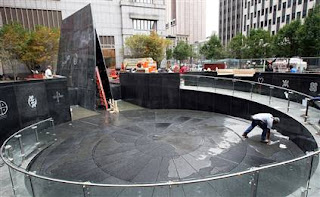
nomenclature: the burial ground, the national monument, the memorials - city memorial in Foley Square, Triumph of the Human Spirit, and the federal memorial, The Ancestral Libation Chamber Memorial dedicated the weekend of October 6Th. We have since seen some 40 thousand visitors to the monument.

In 1991, when it was discovered by the African Descendant community what had been uncovered by the government and what disrespectful treatment was being afforded the discovery, the burial ground became a focus of action for the descendant activist community and word went out urging folks to attend the regular protests, ceremonies, and commemorations that were being conducted to support the elders who were leading the fight to halt the exhumations and the construction and assure proper respect for the remains of the ancestors.

Like many others, as my work schedule permitted, I visited the burial ground to lend my support. After the initial success and the dispatch of the remains to Howard for study, I assisted the government funded Office of Public Education and Information, both as a volunteer, at their various educational events, and as a volunteer consultant in automating their mailing list.

After the return of the remains from HU and the subsequent designation of the burial ground as a national monument, I began to volunteer as a docent, giving tours of the monument and the art work commissioned for the burial ground. I have been giving a tour of "Old Manhattan and its African Past" for many years, and the burial ground was a logical involvement for me, especially after my retirement.


2. What impact has working with the African Burial Memorial had on you?

Impossible to truly assess. It has been a profound turning point in my life. It has set me on one of the steepest learning curves of my intelectual life and on a spiritual journey that has only just taken its first baby steps. I have embarked on a literary challenge that is testing my craft in new and expanding directions.

The Burial Ground has become a focus for my retirement. There is the time there doing tours, the time spent reading, digeting, considering and learning new things about Manhattan and its African past, the efforts to capture the voices of African New Yorkers in my poem-becoming multi-media-performance-piece, and the persuit of the spiritual understanding I am being offered - all this and much more that I don't even have words for.
Can you recall how it has affected others?

The reactions vary, from surprise at all that visitors have not known before, to appreciation for the recognition and acknowledgement the ancestors are receiving, to a profound sorrow at the circumstances of early African Manhattanites. The many students of every age leave with an understanding of their history, Euro and African descendant alike, that was not previously available to them. The affect on them will only become evident as they become adults and we see the real impact of what they have learned on their committment to justice and peace.

There are those in the African descendant community who harbor deep disapointment that the sacred ancestroral grounds are not under the control of the African descendant community. The government building and the present federal memorial area should not, these elders suggest, have been built on at all, but the grounds should have been preserved as a completely undeveloped green space with signage.

While I respect and understand their position, I think that the educational potential of the monument as a national monument, with its visitors center and memorial, offer a greater educational opportunity, one that would be understood by the ancestors whose remains we honor.


3. How frequent do tours take place?

The visitors Center is currently housed within the Federal Building at 290 Broadway open from 9 to 5, Monday through Fridey, except on Federal holidays. There is a 25 minute video available and a walking tour of the commemorative art work in the lobby of the building on the site as well as of the memorial. Sometime in 2008, we will see the opening of a new visitors center in teh 290 building that will have its own enterance and allow us to be open 9-5 every day except major holidays.

Currently, there is a Park Ranger available at the memorial to provide tours of the The Ancestral Libation Chamber Memorial 9-5, every day except major holidays.

Group tours can be arranged by visiting the official National Park Service burial ground web site at http://nps.gov/afbg. Tours can be arranged for Monday through Friday, 9 to 5 or at other times, by special arrangement. Off site presentations can also be arranged. The current visitors Center can only accomodate 30-45 people at a time for a presentation of the video about the burial ground and I recomend that groups plan a visit of 90 minutes to two hours to fully benefit from the monument's resources. When the new visitors center is opened next year, we will have facilities to accomodate larger groups.

Sunday, August 12, 2007

An Interview with E. Ethelbert Miller


It was during my first semester at Howard that I met E. Ethelbert Miller. After tellng my English Professor that I was going to be a writer she pointed to Founders Library and said "You need to go meet Ethelbert Miller." Every now and again I make the three flight trek up to Ethelbert's office in the African American Reading Room at Founders' Library on the campus of Howard University.

Ethelbert represents a bridge: he was a student when Sterling Brown and others were at Howard. My getting to know Ethelbert Miller, in a way connects me to a large tradition of black writers that include Sterling Brown, the Black Arts writers that were coming of age around the time Ethelbert was a student at Howard and the youngins' like me who are struggling with their own words to tell the truth and simultaneously add beauty and possibility to this world.


A special thanks to poet-friend Melissa Tuckey for providing this photograph of E. Ethelbert Miller.


Abdul Ali: Can you tell me what a literary activist is, and what kinds of work they take up? When did you become a literary activist, what events revealed this calling?

Ethelbert Miller: People often inquire about what I do. Terms like poet, writer or teacher I find to be too restrictive. During a typical day, I’m involved in numerous projects and find myself representing several institutions and organizations. A considerable amount of my work is political and not literary. Social activism has always been important to my life. I feel everyone should be here to improve the social conditions of this world. I coined the term literary activist a few years ago. One other person I’ve seen embracing the term has been my friend Natalie Handal, a Palestinian poet and playwright.

Two of my major concerns are promoting other authors and documenting and preserving literary history. From 1974- 2000, I coordinated the Ascension Poetry Reading Series, which gave many African American writers residing in Washington their first public readings. Recently I’ve been archiving my own personal collection with three institutions: University of Minnesota,George Washington University and Emory and Henry College. Since the early 1970s I’ve been saving correspondence, flyers, and manuscripts from several hundred writers. I keep hundreds of files in the African American Resource Center at Howard. This material has been very helpful to scholars doing research, especially into the Black Arts Movement.

In May 1984, I helped to create the Poet Laureate position and honor Sterling A. Brown with the title. Years later, I would recommend Delores Kendrick to be the second Poet Laureate of Washington, D.C.

As a literary activist I’ve sat on the boards of many literary organizations, including The PEN American Center, PEN/Faulkner Foundation, The Associated Writing Programs (AWP) and The Writer’s Center in Bethesda, Maryland. Each year I read grant proposals, judge poetry contests and write blurbs and letters of recommendation for writers. One project I accomplished back in 1997 was placing the images of twelve African American writers are stamps coming out of Uganda and Ghana. Those writers were: Mari Evans, Stephen Henderson, June Jordan, Alex Haley, Zora Neale Hurston, Henry Louis Gates, Jr, Charles Johnson, Richard Wright, Maya Angelou, Rita Dove, Sterling A. Brown and Toni Cade Bambara.

I think some of us must do more than simply write. There will always be a need to protect, promote and preserve African American literature.

AA: I’ve noticed that Islam occupies a prominent space in your poetry. Can you speak to why Islam is important to you?

EM: In the 1970s I was reading many books about Eastern religions. I was attracted to Sufism and was influenced by the writings of Hazrat Inyat Khan. I remember purchasing some of his books from the old YES bookstore in Georgetown. In 1970, I took my Shahada at a community mosque located in the Bronx. I think the spiritual path I found myself on was no different from the one my older brother (Richard) had undertaken in the early 1960s. His journey encouraged him to join a Trappist monastery in upstate New York. My brother and I were searching for answers that would help explain the meaning of life. Siddhartha by Herman Hesse is one of my favorite books.

References to Islam appear in a number of my poems. In my last collection How We Sleep On The Nights We Don’t Make Love one will find the poem “Salat” on the first page. I wrote this poem while in Saudi Arabia:

SALAT

poetry is prayer
light dancing inside words

five time a day
I try to write

step by step
I move towards the mihrab

I prepare to recite
what is In my heart

I recite your name


American writers (in the future) will further explore Islam; it’s an outgrowth of how our world is changing. It will be important for many of us to visit places like Indonesia and Turkey. Islam is having a significant influence on the African American community. This is something Malcolm X predicted would happen. Islam is one of the fastest growing religions in the United States. Look for African Americans to play a key role in how Islam can best coexist with modernization and western values. Look for Islam to move African Americans beyond the 20th century’s double consciousness that DuBois described. In the 21st century, a person will talk about their triple identity. They will mention how they are Muslim, American and Black.


AA: I often tell my writer-friends that you are Howard’s unofficial MFA program. How did you earn the reputation as the go-to person for emerging writers?

EM: Well, I think Howard University needs an MFA program. In 1993, I was advocating the need for historical black colleges to have creative writing programs. I did this while serving as the Vice President of the AWP board. I pulled together a panel to discuss the topic at an AWP Conference in Philadelphia. One person I invited to give a presentation was Cornelius Eady. I think one of the reasons why Chicago State University (today) has a creating writing program is because Haki Madhubuti was one of the black writers who helped support the concept. Others were Marita Golden, Sonia Sanchez and Al Young. I invited them to a conference I organized in Norfolk in 1993, to meet with representatives from twelve historically Black colleges. The schools represented at the meeting were: Univesity of Arkansas, Pine Bluff, Dillard University, Howard University, Lincoln University in Missouri, Lincoln University, Pennsylvania, Norfolk State University, Prairie View A& M University, Spelman College, Southern University at New Orleans, Tennessee State University, Texas Southern University and Virginia State University.

The only people at Howard who were ever supportive of developing a creative writing program at the university were Claudia Tate, Sam Hamod, and Jennifer Jordan. Today Howard needs an MFA program. There’s no excuse for not having one.

If I have a reputation as the go-to guy it’s because when I arrived on Howard’s campus (1968) a number of people were helpful to me. I’m simply keeping a tradition alive. I wouldn’t be successful if people at Howard, like Stephen Henderson, Sterling A. Brown, Haki Madhubuti, Julian Mayfield, Jennifer Jordan, Arthur P. Davis, Clay Goss hadn’t been generous with their time and advice.

Working in one place for almost 40 years can also help a person merge their identity with an institution. That’s what has happened to me. When people think “writing” and “Howard,” my name is mentioned. In the old days the first name was Sterling Brown, maybe you would say Owen Dodson if you were very serious. Today, I’m ready to look over my shoulder to see who is coming after me. There is still so much work to do.


E. Ethelbert Miller is a literary activist. He is the board chair for the Institute for Policy Studies, a progressive think tank located in D.C. He was awarded an honorary doctorate of literature from Emory & Henry College in 1996. In 2003 his memoir Fathering Words was selected by DC WE READ for its first book, a city program sponsored by the D.C. Public Libraries. In 2004, Mr. Miller was awarded a Fulbright to visit Israel. Poets & Writers presented him with the 2007 Barnes & Noble/Writers for Writers Award. Mr. Miller is often heard on National Public Radio.

Tuesday, July 24, 2007

Interview with Sarah Browning

Abdul Ali: How did your title come to you? It's actually quite clever and appropriate..."Whiskey in the Garden of Eden." It's a dramatic incongruity.

Sarah Browning: Thank you. The title comes from a poem in the book called, “Things They Never Tell You.” The poem asks, “Was there whiskey in the garden – / heat to cool / the blood that calls / to the blue wing at the edge of the sky?”

So whiskey is both the transgressive (the bad girl in the garden) and a tonic to dampen down the longing, the blue wing. The poem concludes:

There is that apple.
They don’t say
how long Eve dreamed
of reaching

– her belly taut with the tang of it –

before she took.

At the time I wrote the poem, I was preoccupied with the question of women’s ambition and longing. I think we have a very complicated relationship to these things in our society – witness the really hateful misogyny so often directed at women who are ambitious or sexually assertive. In those years I was asking myself: What is it OK to want? I come from a family that emphasized putting others first, which is a good thing, of course, but it meant that it didn’t feel alright to want things for myself. I’m doing a lot better with this now, thanks in part to writing about it.

As an aside, I should note that titles are very hard for me in general. The book had four or five as a manuscript and I lately came across a page in a notebook on which I tried out another 15 or 20 options. I’m glad the final choice is a hit.


Abdul Ali: You sensitively deal with themes ranging from feeling like an outsider moving into a "Chocolate City" and being a political activist. Can you speak on the different voices that you assume in this work?

Sarah Browning: The fact is that I always write from who I am, we all do. I try to write from the experience as honestly as I can.

I was born into an activist family and grew up on the South Side of Chicago in the late 60s and early 70s. It was a time of war and intense social change. The neighborhood was mixed, racially and by social class. So, unlike some white people, who grow up without an awareness of their race, I have always been acutely aware of the fact that I am white and middle class (my father was an academic, my mother a social worker and then a health administrator). And of the privileges that my skin color afford me. I studied American social history in college and have worked as a community organizer in public housing and as a political organizer. So I know our history and am aware of the fact that social forces are always present in all our human interactions. A poem in the book about an encounter with a young Black man when I was 13 or so says “so much / of our history is in this moment / … 400 years that brought us to this street.”

When I moved to DC, I had lived in a very monochromatic part of Massachusetts for several years and so I was at first acutely aware of my race. And I bought a house in Petworth, a predominantly African-American neighborhood. By doing so, I am contributing to the gentrification of the city and of Petworth. I have many conflicted feelings about it: On the one hand, it is outrageous that housing prices have climbed so high that people who grew up in Petworth can’t afford to buy a house here. That long-time DC residents are being forced out of the city. On the other hand, I don’t want to live in an all-white neighborhood and I couldn’t afford to buy a house in one even if I wanted to. So I bought here. I want to live in a vibrant, diverse city, where people of all races, ethnicities, and social classes live side by side and enrich each other’s lives. That’s what I want for my child. We’ll have to work hard to make that happen and it may be too late. I don’t know.

In the poems I try to be truthful about the complexity of these issues – how they feel, how they are lived (by me, that is; of course they are lived very differently by others). As the great Sekou Sundiata, who we so sadly lost last week, said, these are questions of the first person plural; that is, they are deeply personal issues that implicate each of us personally and they are public issues as well. I try to hang out at that intersection as much as possible.

Abdul Ali: How long did it take you to complete this book? What was your hardest challenge finishing this work?

Sarah Browning: Oy – I knew someone would ask this question eventually. This is my first book of poems. I started writing seriously about 15 years ago and almost right away began publishing poems in literary journals. I first put a manuscript together 10 years ago. It bears very little resemblance to Whiskey in the Garden of Eden – just a handful of poems remain from that first version. I sent it to the ridiculous first-book prizes out there off and on (spending a ton on copying and postage costs, entry fees…), all the while revising and renaming. I had a baby. I tore the manuscript apart and sat on it for a year. Friends made very helpful suggestions on structuring it. And finally, I was fortunate enough to be approached by the folks at the Word Works, who asked me if I had a manuscript and then were kind enough to decide to publish it.

So the challenge of finding a publisher was significant. But more importantly, the poems about race, and especially about how race often played itself out on the streets of my childhood, were very difficult to write, very vulnerable, very scary (more on this below). It took me many, many years and drafts to write and complete these poems and to feel OK about putting them out in the world. And then they needed to find their right place within the book. When I finally figured out their position – in the second section called “Some Borders,” after a first section of poems written about Washington, DC, the war, raising a child in these circumstances – I realized that the book was at last done, and ready to be launched.


Abdul Ali: What sustains your activism?

Sarah Browning: That I am not alone. I find community in the other spectacular poet-activists here in DC who I am privileged to call friends, companions, inspiration. I find community in the poets I read – from Walt Whitman to June Jordan to Muriel Rukeyser to Pablo Neruda to our living contemporary writers. And I know our history: that all the great improvements to our society have come as a result of social movements: the right to vote – for women and people of color; the 40-hour work week; the end to the Vietnam War. We have a long way to go but only we can take us there, the poets and the activists. As Paulo Freire says, we make the way by walking.


Abdul Ali: Your poem "The Beautiful African American Workshop Leader Tells Us to Write About Difference" is probably one of your most vulnerable poems. You even write in all italics. Can you expand on why you made that choice? And how you navigate feeling different in the various spaces you travel through in the DC area?

Sarah Browning: The poem relates an experience I had when I was probably 6 or 7, of older Black girls throwing rocks at my friend and me as we walked home from the library, holding hands. My friend was Black and I am, obviously, white. The girls were giving my friend, who I call Robin in the poem, a hard time for being friends with a white girl. They called me a honky bitch. This was not an isolated incident but because I was so young it seared itself on my consciousness.

I tried to write about this experience for many years. But it made me very uneasy. And still does. It was a very specific historical moment – it would have been about 1969 or 1970: the height of the Black Power Movement, of separatism. And a time when Black people were feeling empowered to express their very legitimate anger at a deeply, malevolently racist society. Of course two six-year-old girls are never an appropriate target for anger, but that’s often how things work: suppressed anger explodes and the target hardly matters. Little kids, of course, don’t understand these things and there was very little discussion in my household about that anger and that threat of violence. We basically pretended it wasn’t going on.

There is a lot of silence from white people about race. Because these stories are a part of my experience of race (though only a part – I had close Black friends all through my childhood and spent many hours of warmth and grace with them and their families), I felt that it was important to write about them. But we do still live in a very racist society and I didn’t want to give fodder to the racists by telling these stories in a cavalier manner. And I certainly didn’t want to equate my experience with that of Black children who face a daily, grinding racism – from the media, popular culture, and our leaders, as well as in personal encounters from an early age. As Ethelbert Miller pointed out when we talked about this, I could easily escape this tension by leaving the city, going elsewhere, visiting relatives; while Black people live with a permanent unease and uncertainty.

So I wanted to be very careful in the way that I presented these poems. I wrote this particular poem dozens of times, trying to get it right. One of the times I wrote it, I was the only white person in a writing workshop at a conference Black Voices for Peace had organized. The workshop leader really did give us this exercise, to write about the first time we learned about difference. I wrote the story of the girls and my friend Robin, but didn’t get up and read what I’d written. Later I wrote about the uneasiness I had felt writing the story in that setting. One of the challenges with these poems was how to balance the child voice – the direct relating of the experience itself – with the adult voice of understanding what was going on. I finally realized that the title could provide that framing adult perspective. So the whole poem, the story itself, is in italics, as being remembered by the adult self, in a self-aware act of writing.

I was still wrestling with this material when I moved to DC and it has been in discussion with several writer-activists (most particularly E. Ethelbert Miller, as I mentioned before, Yael Flusberg, Michele Elliott, Becky Thompson, and Reuben Jackson) that I was able to come unstuck. I am very grateful to them and to all the other writers and activists in this city – Black, white, Latino, Asian – who have encouraged me to write honestly about race. It’s scary, but I know it is worth it. We only make progress by taking risks and talking with one another honestly, across our differences and in the presence of our similarities. I know that poetry can reach across these chasms, humanize us for one another. If we open ourselves to it. In these desperate times, I feel we don’t have a choice. We have to choose poetry.